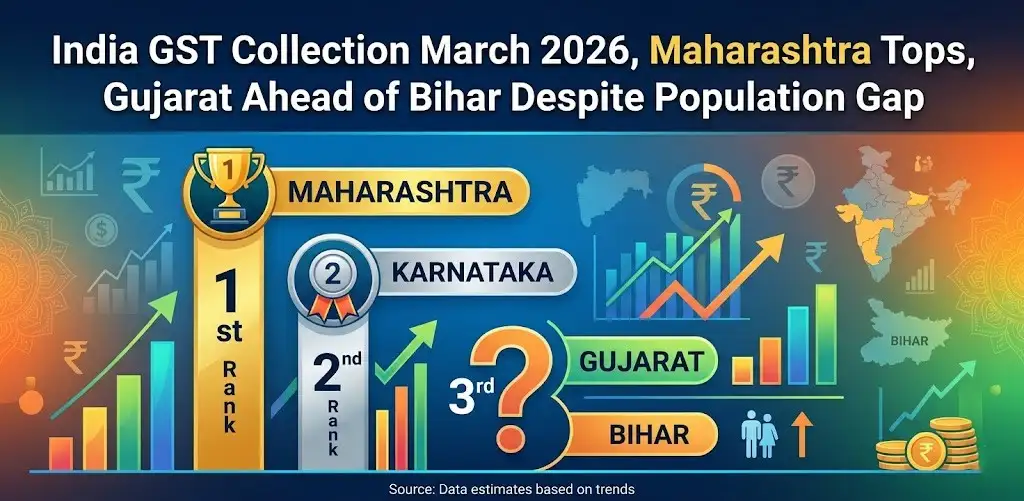
India GST collection March 2026 data shows Maharashtra leading while Gujarat outperforms Bihar despite a smaller population. Here is the full state wise GST breakdown and key insights.
India GST collection data for March 2026 highlights strong revenue performance from states like Maharashtra, Karnataka and Gujarat. Despite having a smaller population, Gujarat collected significantly more GST than Bihar, reflecting differences in industrial activity, economic structure and tax base across states.
The latest GST collection figures for March 2026 offer an interesting snapshot of India’s economic activity across different states. The data not only reflects revenue trends but also reveals how industrial growth, consumption patterns and economic structure vary widely from one region to another.
Maharashtra once again emerged as the top contributor, reporting GST revenue of 15767 crores. The state continues to dominate due to its strong industrial base, financial sector presence and high consumption levels, especially in cities like Mumbai and Pune.
Karnataka followed with 7417 crores, supported by its thriving technology sector and urban economy centered around Bengaluru. Uttar Pradesh reported 6969 crores, while Tamil Nadu contributed 6764 crores, both states benefiting from a mix of manufacturing, trade and population driven consumption.
Gujarat recorded GST collection of 6193 crores, placing it among the top performing states. Known for its strong industrial ecosystem, export driven economy and business friendly environment, Gujarat continues to maintain a high tax contribution despite having a smaller population compared to some other large states.
A comparison between Gujarat and Bihar has drawn attention on social media. Bihar, with an estimated population of around 13 crore, reported GST collection of 3252 crores. In contrast, Gujarat, with roughly half the population, generated nearly double the revenue. This gap highlights the difference in economic activity, industrialization and per capita income between the two states.
Other states also showed notable performance. Rajasthan reported 4036 crores, West Bengal 3962 crores and Telangana 3685 crores. Madhya Pradesh and Haryana remained close, with collections of 3368 crores and 3200 crores respectively. Delhi, despite its smaller geographical size, recorded 3148 crores, reflecting its strong service sector and business activity.
Southern states like Andhra Pradesh and Kerala contributed 3015 crores and 2731 crores respectively. Odisha reported 2552 crores, while Chhattisgarh and Punjab recorded 2061 crores and 2028 crores.
Smaller states and union territories showed relatively lower collections, which is expected due to their limited population and industrial base. Assam reported 1435 crores, Jharkhand 1306 crores and Uttarakhand 772 crores. States like Himachal Pradesh, Goa and Jammu and Kashmir reported moderate figures, while northeastern states and union territories remained at the lower end of the list.
The data has also sparked discussions around governance, employment policies and economic planning. Some social media users have compared states based on revenue and administrative decisions, raising questions about workforce policies and economic priorities. However, experts often point out that GST collection alone cannot fully define a state’s overall development, as factors like cost of living, infrastructure, investment inflow and social indicators also play a crucial role.
Overall, the March 2026 GST figures underline the importance of industrial growth and economic diversification. States with strong manufacturing, services and trade networks continue to generate higher tax revenues, while others are gradually working to expand their economic base.
As India’s economy evolves, such data provides valuable insight into regional performance and highlights where opportunities for growth and policy improvement may lie.