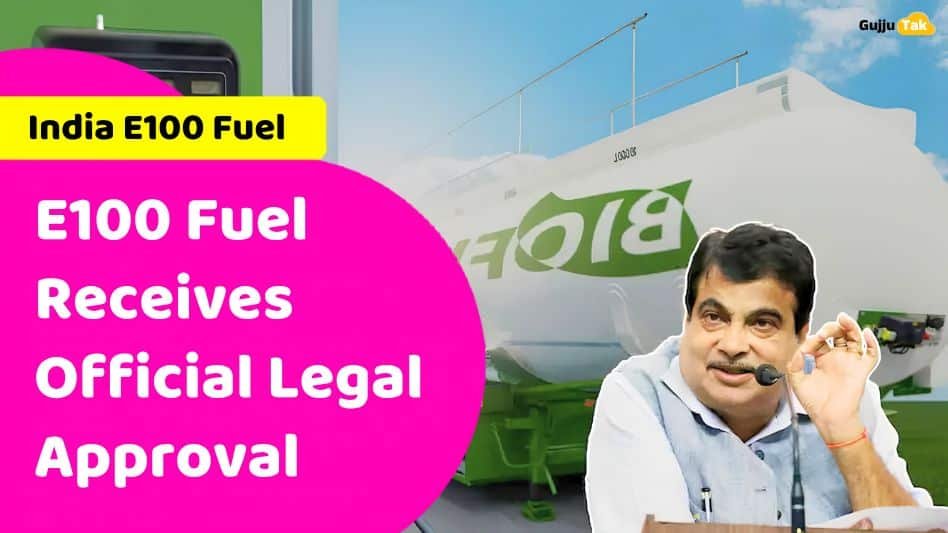


New Delhi: India has taken a significant step toward cleaner and more self-reliant transportation by granting legal recognition to E100 fuel, a fuel consisting of 100% ethanol. Union Road Transport and Highways Minister Nitin Gadkari has signed the necessary regulations, creating a legal framework for the use of E100 as an automotive fuel in the country.
The move is being seen as a major milestone in India’s efforts to reduce dependence on imported crude oil, promote alternative fuels, and strengthen the country’s biofuel ecosystem. Industry experts believe the decision could accelerate the adoption of flex-fuel vehicles and reshape the future of India’s transportation sector.
E100 Fuel Receives Official Legal Approval
India has been actively promoting ethanol blending in petrol over the past few years. While ethanol-blended petrol has already become common across the country, the latest decision extends legal recognition to pure ethanol fuel, known as E100.
With the regulations now signed, the pathway has been cleared for commercial deployment, infrastructure development, and vehicle technologies designed specifically for E100 fuel. Experts describe the move as a transformative step that could significantly reduce India’s reliance on conventional fossil fuels.
Major Opportunity for the Automobile Industry
The approval of E100 fuel is expected to encourage automobile manufacturers to develop engines capable of operating entirely on ethanol. Several domestic and global automakers have already showcased flex-fuel vehicle prototypes in recent years.
With regulatory clarity now in place, companies may accelerate investments in research, production, and commercialization of ethanol-powered vehicles. Industry observers expect a gradual increase in the availability of flex-fuel and ethanol-compatible vehicles in the Indian market over the coming years.
Farmers Set to Benefit from Increased Ethanol Demand
One of the most significant beneficiaries of the policy could be India’s agricultural sector. Ethanol production primarily relies on crops such as sugarcane and maize, along with other agricultural feedstocks.
Higher demand for ethanol could create additional market opportunities for farmers, improve rural incomes, and support the growth of agriculture-linked industries. Experts believe that expanding the biofuel sector can strengthen rural economies while providing productive use for surplus agricultural output.
Reduced Oil Imports and Cleaner Mobility
India currently imports a large share of its crude oil requirements, making the economy vulnerable to global energy price fluctuations. Increased adoption of E100 fuel could help reduce import dependency and save valuable foreign exchange.
Ethanol is also considered a cleaner-burning fuel compared to conventional fossil fuels. As a result, wider use of ethanol-powered vehicles could contribute to lower emissions and support India’s long-term environmental and climate goals.
Government officials view the transition toward biofuels as an important part of the country’s strategy to achieve cleaner transportation and reduce carbon emissions.
Infrastructure Development Remains the Next Challenge
While the legal framework has now been established, large-scale adoption of E100 fuel will require substantial infrastructure development. Fuel stations, storage facilities, transportation networks, and distribution systems will need to be upgraded to handle pure ethanol efficiently.
Industry stakeholders and oil marketing companies are expected to work closely with government agencies to develop the required ecosystem in a phased manner. Technical modifications may also be necessary to ensure safe storage and transportation of ethanol-based fuels.
A New Direction for India’s Energy Future
The approval of E100 regulations signals India’s growing commitment to alternative and domestically produced energy sources. If implemented successfully, the initiative could benefit farmers, reduce fuel import bills, encourage innovation in the automobile sector, and offer consumers a cleaner mobility option.
As India moves toward greater energy security and sustainability, E100 fuel could play a crucial role in shaping the next generation of transportation across the country.
FAQ
Has India officially approved E100 fuel?
Yes. The government has completed the legal framework for E100 fuel after Union Minister Nitin Gadkari signed the relevant regulations.
What is E100 fuel?
E100 is a fuel made of 100% ethanol and can be used in specially designed ethanol-compatible or flex-fuel vehicles.
How will farmers benefit from E100 adoption?
Higher ethanol demand could increase the use of crops such as sugarcane and maize, creating additional income opportunities for farmers and supporting rural economies.
